New Lucas Museum in Los Angeles: What to See After Its September 2026 Opening
The Lucas Museum of Narrative Art opened in Los Angeles on 22 September 2026, adding an unusual new cultural institution to Exposition Park. Founded by filmmaker George Lucas and business leader Mellody Hobson, the museum is devoted to narrative art: images created to communicate stories, ideas, beliefs and shared experiences. That definition gives the museum a much broader scope than its association with Star Wars might suggest. Visitors encounter painting, illustration, comics, photography, murals, sculpture, cinema and production art within the same institution. Its inaugural displays contain more than 1,200 objects arranged across more than 30 galleries, while the wider complex also includes cinemas, a public research library, landscaped gardens and dining facilities. For travellers visiting Los Angeles after the September opening, the museum can comfortably fill several hours and works particularly well as part of a wider day in Exposition Park.
What Is Inside the Lucas Museum of Narrative Art?
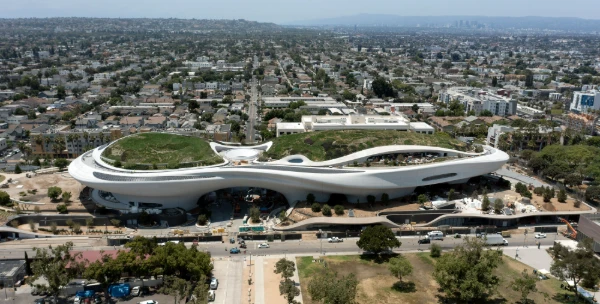
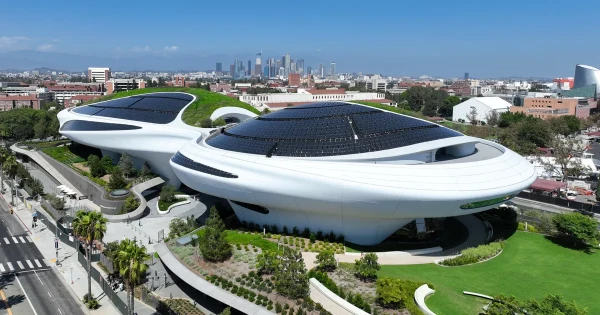
The museum occupies a roughly 300,000-square-foot building designed by architect Ma Yansong and his MAD practice in collaboration with Stantec. Its flowing white exterior is unlike the conventional rectangular form of many major museums, with curved surfaces extending above landscaped ground and pedestrian spaces. Around 100,000 square feet inside the building is devoted to galleries. Rather than organising everything strictly by century, nationality or artistic movement, many rooms are arranged around subjects familiar from everyday storytelling, including family, love, community, childhood, work, play, fantasy and adventure. This approach means that works created in very different periods and media can appear in conversation with one another.
The opening exhibitions demonstrate how wide the museum’s interpretation of narrative art is. The displays move from older religious, mythological and historical imagery to painting, magazine illustration, children’s books, political art, photography, comics and cinema. Artists represented in the inaugural programme include Artemisia Gentileschi, Norman Rockwell, Frida Kahlo, Jacob Lawrence, Charles White, Robert Colescott, Frank Frazetta and Robert Crumb. Mural art also has an important place, with work connected to figures such as Judith F. Baca, Diego Rivera and JR. Visitors therefore should not expect a museum centred solely on Hollywood memorabilia. Film history is important here, but it sits within a much larger account of how images have carried stories across generations.
That mix is one of the clearest reasons to allow plenty of time for a first visit. A Norman Rockwell illustration, comic artwork, a historical painting and a film-production drawing may use completely different techniques, yet the museum asks visitors to consider what each image is trying to communicate and why certain visual stories become part of popular memory. This makes the galleries relatively accessible even for people without a detailed knowledge of art history. The emphasis is less on mastering specialist terminology and more on looking at characters, actions, emotions and ideas. Families, cinema enthusiasts, comic readers and visitors interested in traditional fine art can therefore follow different routes through the same collection without needing identical interests.
Star Wars, Indiana Jones and the Lucas Archives
The Lucas Archives are likely to be among the most familiar parts of the museum for international visitors. The archive developed from materials preserved from Lucasfilm productions and was donated in 2013 to become a foundation of the museum’s collection. It contains props, costumes, artwork and production material covering more than four decades of filmmaking, including the first six Star Wars films and the first four Indiana Jones films. Other represented productions include Willow, Red Tails, Howard the Duck and Radioland Murders. The significance of the archive is not simply that recognisable objects have survived; it also records how imaginary settings, characters and machines moved from initial drawings and design ideas towards their final screen appearances.
The inaugural cinema exhibition, Star Wars in Motion, concentrates on movement and vehicle design across George Lucas’s first six Star Wars films. Among the objects and concepts associated with the exhibition are Luke Skywalker’s Landspeeder from A New Hope and the first physical build of General Grievous’s Wheel Bike from Revenge of the Sith. The wider Lucas collection also includes production artwork by influential designers such as Ralph McQuarrie, Doug Chiang and Joe Johnston. Examples connected with the archive include early views of the Millennium Falcon, the Death Star trench, TIE Fighters, X-wings, Mos Eisley, Tusken Raiders and scenes involving C-3PO and R2-D2. Seen together, these materials show how visual world-building develops long before cameras record the finished scene.
Indiana Jones material adds another strand to the archive, while the broader film holdings prevent the cinema section from functioning as a simple collection of franchise souvenirs. Production drawings, costumes, props and conceptual designs are treated as parts of the visual storytelling process. This context is useful for visitors who know the finished films well but have rarely considered how individual artists helped create their fictional worlds. Someone who comes primarily for Star Wars can therefore spend time with familiar material while also gaining a clearer sense of why concept art, costume design and practical objects matter to cinema history.
Art, Film and Spaces Worth Seeing Beyond the Main Galleries
The galleries are only one part of the visit. The museum opened with a dedicated film programme presented in two 299-seat cinemas: the Robert Flaherty Theater and the Slavko Vorkapich Theater. Screenings run throughout the day on a drop-in basis, so visitors do not necessarily need to organise their entire visit around one conventional film showing. The programme was designed to represent different periods and approaches to moving images, including early silent cinema, animation, documentary and experimental filmmaking. This gives the museum a way to treat cinema as a living form of narrative art rather than restricting film to costumes and objects displayed in cases.
Visitors interested in going deeper into individual artists or subjects can also use the Research Library. The library is open to the public without an additional admission charge and contains general research material, rare books, archives and special collections. Its subjects range across art history, illustration, cinema, folklore, anthropology, literature, design, photography, children’s literature and popular culture. The collection is non-circulating, meaning material is intended for use on site rather than borrowing, while approved researchers can arrange access to particular holdings. For ordinary visitors, however, it also serves as a quieter part of the museum where books and other resources can provide context for works seen in the galleries.
The physical setting deserves time as well. The museum forms part of a landscaped campus in Exposition Park, with approximately 11 acres of park and gardens designed by Mia Lehrer and Studio-MLA within the wider museum site. The gardens include public green space and ten monumental outdoor sculptures, making it possible to spend part of the visit outside rather than moving continuously from one indoor gallery to another. This matters particularly in a district already containing several major Los Angeles attractions. The park and gardens can be visited without a museum ticket, although access to the wider site may occasionally be controlled when visitor numbers are high.
Architecture, Gardens and Skywalker Grill
The building itself has quickly become one of the museum’s principal sights. Its long, curved profile rises above the surrounding landscape with few obvious references to conventional museum architecture. Ma Yansong’s design links the structure to the gardens below, while pathways and planted areas soften a location that was previously dominated by paved space. Large interior volumes, curved circulation areas and views towards the surrounding park continue that relationship indoors. Visitors who are interested in contemporary architecture may therefore want to walk around the exterior before or after seeing the collection rather than approaching the building only as a container for exhibitions.
The gardens provide another reason not to rush directly from the entrance to the galleries. They were conceived as public space for both museum visitors and the surrounding South Los Angeles community. Trees, planted slopes, paths, lawns and outdoor artworks create areas where visitors can stop between exhibitions or remain after leaving the ticketed sections. The park normally opens at 8 am and closes at sunset, which gives it longer morning access than the museum itself. Although the roof garden is reserved for private events and is not part of normal public access, the ground-level landscape remains an important element of the overall visit.
Food is available inside the complex, including the museum’s signature restaurant, Skywalker Grill. The restaurant is open to people who are not visiting the galleries and serves modern American food, with seafood, grilled dishes, pasta, salads, desserts and a children’s menu among its offerings. Lunch, dinner and weekend brunch make it possible to incorporate a meal into a longer day at Exposition Park. A café is another option for visitors who do not want a full restaurant meal. Neither the park and gardens, museum shop, café nor Skywalker Grill requires a gallery ticket, although reservations are sensible for the restaurant and access to the campus can be restricted temporarily when capacity is reached.
How to Plan a Lucas Museum Visit in 2026
The Lucas Museum of Narrative Art is at One Lucas Plaza, 3800 South Vermont Avenue, in Los Angeles’s Exposition Park. Its location places it close to several established attractions, so travellers can combine it with other museums and cultural sites in the district if they have a full day available. The museum is open from 10 am to 5 pm on Monday, Wednesday and Thursday; from 10 am to 9 pm on Friday; from 9 am to 9 pm on Saturday; and from 9 am to 5 pm on Sunday. Tuesday is the regular closing day. Last entry is 45 minutes before closing, although arriving that late would leave very little time for a collection of this size.
General adult admission costs $25 in the opening period, while admission for visitors aged 65 and over is $21. Children and teenagers aged 17 and under receive free general admission, as do active-duty military personnel, personal aides or attendants and eligible EBT cardholders. A free ticket still needs to be reserved for children because everyone entering the galleries requires a timed admission slot. General admission covers the galleries, exhibitions and museum theatres on the publicly accessible exhibition levels, but separately priced programmes are not automatically included. Booking a timed ticket in advance is particularly sensible during weekends and the first months following the museum’s opening.
A realistic first visit should allow roughly three to four hours if the aim is to see the principal galleries, spend time with the Lucas Archives and walk through the gardens without hurrying. Visitors who want to watch several film programmes, use the library or examine the inaugural exhibitions carefully could easily remain considerably longer. Friday and Saturday evening hours provide additional flexibility for travellers whose daytime schedules are already full. It is also worth remembering that the scale of the collection makes trying to see every object in one visit unnecessary; choosing several themes or sections usually produces a more comfortable experience than moving quickly through every gallery.
What to Prioritise on a First Visit
For a first visit, a sensible starting point is the inaugural narrative-art galleries. They explain the central idea behind the institution and make it easier to understand why paintings, comics, illustrations, photographs and film objects have been placed within the same museum. From there, visitors with an interest in cinema can continue to Star Wars in Motion and the Lucas Archives before checking the screening programme in the two theatres. This order avoids reducing the museum to its best-known film connection and gives the archive a clearer place within the much longer history of visual storytelling presented elsewhere in the building.
After the main galleries, the library and gardens provide a useful change of pace. The Research Library normally opens at 10 am and closes one hour before the museum, while the park and gardens operate from 8 am until sunset. Visitors do not need a general-admission ticket for these areas, so they can also be visited separately on another day. Someone staying near Exposition Park could, for example, return for the gardens or restaurant without booking another museum entry. That flexibility is useful because the site contains enough indoor and outdoor material to make a single tightly scheduled visit feel unnecessarily rushed.
The Lucas Museum ultimately makes the most sense when approached as more than a museum about George Lucas or Star Wars. Those subjects are substantial parts of the collection, but they sit alongside centuries of paintings, illustration, comics, photography, murals and other forms of image-making. Its opening has created a Los Angeles museum where familiar popular imagery and works traditionally associated with fine-art institutions can be considered together. For visitors arriving after September 2026, the strongest first visit is therefore one that combines several elements: the thematic art galleries, the Lucas Archives, at least a short film screening, time outdoors in the gardens and enough room in the schedule to follow whichever stories prove most interesting once inside.
Popular articles
-
New Lucas Museum in Los Angeles:...
The Lucas Museum of Narrative Art …
-
Limassol and City of Dreams Medi...
Limassol is one of the easiest …
-
Discover Copenhagen: A Vibrant C...
Copenhagen, Denmark’s vibrant capital, effortlessly blends …