Sagrada Família in 2026: What Changed After the Completion of the Tower of Jesus Christ
The Sagrada Família entered a new stage of its history in 2026. On 20 February, the exterior of the Tower of Jesus Christ was completed when the upper arm of its enormous cross was installed, bringing Antoni Gaudí’s basilica to its intended maximum height of 172.5 metres. The milestone changed Barcelona’s skyline and completed the most important of the six central towers, but it did not mark the end of construction. Work continues on several major parts of the church, including the Glory façade and the Chapel of the Assumption. For travellers visiting Barcelona in 2026, the result is therefore unusual: the Sagrada Família has reached the height that will define its permanent silhouette while remaining an active construction site. Understanding that distinction makes it much easier to appreciate what has actually changed, what can be seen during a visit and what still remains to be completed.
The Tower of Jesus Christ Has Redefined the Basilica’s Skyline
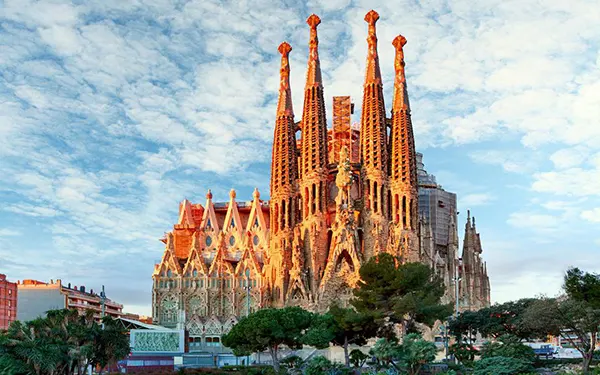
The most important architectural change of 2026 is immediately visible from outside. On 20 February, workers installed the upper arm of the cross on the Tower of Jesus Christ, completing the exterior of the central and tallest tower. The basilica now rises to 172.5 metres above Barcelona, making it the tallest church in the world. The new height is not simply another construction record. Gaudí planned a clear hierarchy among the Sagrada Família’s towers, with the structure dedicated to Jesus Christ occupying the central and highest position. For decades, visitors could understand that idea mainly from drawings, models and explanations in the museum. In 2026, it can finally be read directly in the building’s silhouette.
The cross that crowns the tower is substantial enough to be an architectural structure in its own right. It measures 17 metres in height and 13.5 metres across, roughly comparable in height to a five-storey building. Rather than appearing as a flat cross when viewed from one direction, it has four horizontal arms and a three-dimensional form that can be recognised from different parts of Barcelona. Its exterior combines glass with white enamelled ceramic, materials selected to interact strongly with daylight and to allow the pinnacle to remain visually prominent after sunset. The cross follows the twisting geometric language that appears elsewhere in Gaudí’s work, although visitors do not need to understand the mathematics behind it to recognise the relationship with the rest of the basilica.
The February construction milestone was followed by a major ceremonial event on 10 June 2026, exactly one hundred years after Antoni Gaudí’s death. Pope Leo XIV presided over Mass at the Sagrada Família and blessed and inaugurated the Tower of Jesus Christ. The cross was then illuminated for the first time as part of the event. More than 8,500 people attended the celebration in person, including approximately 4,500 inside the basilica and another 4,000 outside. The date gave the completion of the tower an additional historical significance: a central element that Gaudí conceived but could never expect to see built was inaugurated precisely a century after his death.
Why the New Tower Does Not Mean the Sagrada Família Is Finished
The completion of the Tower of Jesus Christ has sometimes been described as the completion of the Sagrada Família itself, but that is not accurate. What was completed in February 2026 was the exterior of the tallest central tower. This is a major step because all six central towers — Jesus Christ, the Virgin Mary and the four Evangelists — can now be read as a complete group. However, Gaudí’s overall design contains eighteen towers and numerous other architectural elements. Several areas of the church are still being built, restored or finished, so cranes and construction activity remain part of the visitor experience in 2026.
One of the largest unfinished areas is the Glory façade on Carrer de Mallorca. This is intended to become the main entrance to the basilica and represents one of the final major construction phases. Work on its vertical structure is already under way, and the towers associated with this façade are planned to reach approximately 120 metres. The shift in construction priorities became particularly visible in July 2026, when the large central crane was reduced in height to 174 metres. Its earlier configuration was needed for work on the Tower of Jesus Christ; it is now being used primarily for construction connected with the Glory façade.
Other work continues away from the most obvious skyline changes. The Chapel of the Assumption is being built beside the apse, together with adjoining parts of the cloister, while work also continues on other remaining sections and restoration projects. In March 2026, the Chapel of the Assumption had reached about eight metres of its eventual planned height of 30 metres. The project therefore has a substantial amount of work ahead even though its tallest point has been achieved. There is currently no reason for visitors to treat 2026 as the year when every element of the basilica became complete; it is better understood as the year when the central tower group reached its defining form.
What Visitors Will Notice at the Sagrada Família in 2026
For somebody returning to Barcelona after several years, the most obvious difference is the skyline. The Tower of Jesus Christ now establishes a strong central point above the surrounding Evangelist towers and the Tower of the Virgin Mary. Views from the streets and open spaces around the basilica are therefore different from those familiar from photographs taken only a few years ago. The contrast is especially clear when approaching along Avinguda de Gaudí or looking across Plaça de Gaudí, where the relationship between the older façades and the newer central towers is easier to see. Construction equipment remains visible, but the highest part of the building now has the form that is intended to remain permanently.
Inside the basilica, the new tower also helps make Gaudí’s organisation of the building easier to understand, even though the Tower of Jesus Christ is not currently included in normal tourist tower tickets. Standard tower visits continue to use one of the towers on the Nativity or Passion façades. The Nativity option provides views towards the eastern side of Barcelona, while the Passion option looks more towards the city centre. Visitors should therefore not buy a tower ticket expecting to ascend the newly completed 172.5-metre central tower. Work on internal elements of the Tower of Jesus Christ has continued during 2026, including its interior and lift installation, but that is separate from the tower routes sold to ordinary visitors.
The other noticeable reality is the scale of demand. The Sagrada Família recorded 4,877,567 visitors in 2025, slightly more than in 2024, and it remains one of Barcelona’s busiest attractions. Entry is tied to a specific time, and tickets are issued in the visitor’s name. Official identification may be requested when entering. This makes advance planning particularly useful during busy periods rather than arriving with the expectation of buying any available ticket immediately. Since February 2026, the basilica has also had a daily quiet hour between 9:00 and 10:00, during which visits continue but visitors are expected to remain silent and use earphones for audio material.
Tickets, Tower Access and Practical Planning in 2026
As of September 2026, the official basic admission price is €26 for an adult. This ticket includes entry to the basilica, access to the museum and the official audioguide through the Sagrada Família app. A guided visit costs €30, while admission including one of the visitor towers costs €36. A guided visit combined with tower access costs €40. Reduced prices are available for several categories, and children under 11 receive free basic admission. Because prices and availability can change, it is sensible to check the official ticket information shortly before travelling rather than relying on an older Barcelona guidebook or a third-party ticket page.
Tower access requires more physical effort than a standard visit. Visitors normally travel upwards by lift and descend on foot using the stairs. Children under six are not allowed to visit the towers, while visitors aged between six and sixteen must be accompanied by an adult. The tower route is not suitable for people with reduced mobility or some forms of functional disability. Access can also be affected by weather, maintenance or safety requirements. Anyone primarily interested in the interior, façades and museum can still see the principal architectural features without adding a tower visit, so the more expensive ticket is not essential for understanding the building.
The 9:00 to 10:00 quiet hour can suit visitors who prefer a calmer atmosphere, but it comes with stricter expectations about noise. At other times, the usual rules of an active Catholic church still apply. Clothing must be appropriate, personal belongings are checked at the entrance and eating or smoking inside is prohibited. Tickets are valid for their assigned time, so arriving early enough to pass the security checks is important. The museum is also worth allowing time for because it provides useful context for the construction process, Gaudí’s surviving models and the relationship between the architect’s original work and the sections completed by later generations.
How the 2026 Milestone Changes the Way Gaudí’s Design Is Read
Construction of the Sagrada Família began in 1882, and Gaudí took over the project the following year. He knew that a building of this scale would continue long after his lifetime, so the church developed through models, plans, surviving fragments and the work of generations of architects and craftspeople. The completion of the Tower of Jesus Christ is important because one of the clearest parts of his symbolic arrangement can now be seen at full scale. The eighteen planned towers represent twelve Apostles, four Evangelists, the Virgin Mary and Jesus Christ. Their different heights create a hierarchy that places the central tower above all the others.
That hierarchy is much clearer in 2026 than it was even a few years earlier. The four Evangelist towers form a group around the Tower of Jesus Christ, while the Tower of the Virgin Mary stands nearby and is connected with the central composition. From the streets below, these elements now read less like separate construction projects and more like a single architectural group. The enormous cross gives the highest tower a visually distinct ending instead of allowing it simply to continue the vertical language of the surrounding spires. For visitors who have seen older photographs of Barcelona, this change is one of the easiest ways to understand how dramatically the basilica has evolved in a relatively short period.
It is also useful to distinguish between the historical sections directly associated with Gaudí and the wider modern construction. The entire Sagrada Família is not individually listed by UNESCO as a completed World Heritage property. UNESCO’s Works of Antoni Gaudí listing specifically includes Gaudí’s work on the Nativity façade and the crypt of the Sagrada Família, alongside six other properties associated with the architect. These older parts remain particularly important for understanding what was executed during Gaudí’s lifetime and under his direct influence. The new central towers belong to the continuing realisation of the much larger church he planned, making a visit partly an encounter with historic architecture and partly with an extraordinary long-term building project.
What Is Still Worth Watching After the Jesus Christ Tower
The Glory façade is likely to produce the most noticeable future change for repeat visitors. It faces Carrer de Mallorca and is intended to become the basilica’s principal entrance, meaning that its completion will affect both the exterior appearance and the way people approach the building. Construction of its supporting elements and towers is already active, and the reduction of the central crane in July 2026 illustrates how resources are shifting towards this area now that extremely high lifting operations around the Tower of Jesus Christ are no longer required. Someone visiting again in several years may therefore find that this side of the Sagrada Família has changed more visibly than the now-completed central pinnacle.
The Chapel of the Assumption and adjoining cloister sections provide another reminder that the remaining work is not limited to large towers. Gaudí planned the church as a connected architectural and religious composition in which façades, chapels, sculpture, light and circulation all contribute to the whole. Work in 2026 includes sculpture and stonework as well as large structural components. Restoration is also part of the process: while new sections are being added, parts that have already stood for many decades require attention. The result is a building site where new construction and conservation take place at the same time.
For travellers, the key change in 2026 is therefore more precise than saying that the Sagrada Família is finally finished. Its tallest and most symbolically important tower is complete, the basilica has reached its permanent maximum height of 172.5 metres and the central group of towers now dominates Barcelona much closer to the form Gaudí intended. At the same time, work on the Glory façade, Chapel of the Assumption and other remaining areas continues. A visitor arriving in 2026 sees both sides of the story at once: a historic milestone that permanently altered the skyline and an unfinished building whose appearance will continue to evolve after the centenary year.
Popular articles
-
Sagrada Família in 2026: What Ch...
The Sagrada Família entered a new …
-
Singapore in 2026: Marina Bay, t...
Singapore’s Marina Bay is entering a …
-
Meteora in Greece: Cliff-Top Mon...
Meteora is one of the few …