Meteora in Greece: Cliff-Top Monasteries and Routes for a First Visit
Meteora is one of the few places in Greece where the landscape, religious history and practical experience of travelling are impossible to separate. Huge stone columns rise above the Thessalian plain near Kalabaka and Kastraki, while centuries-old monasteries occupy ledges and summits that once seemed almost unreachable. Six monasteries remain open to visitors, but seeing them properly requires more planning than simply following the mountain road. Opening days differ, stairways vary considerably, parking is limited at busy times and the religious dress rules apply to every visitor. This guide explains which monasteries suit a first trip, how to group them into sensible routes and what to check before travelling in 2026. It also considers walking options, accessibility, seasonal conditions and the advantages of staying overnight rather than attempting a hurried return trip from Athens.
Why Meteora Deserves More Than a Quick Photo Stop
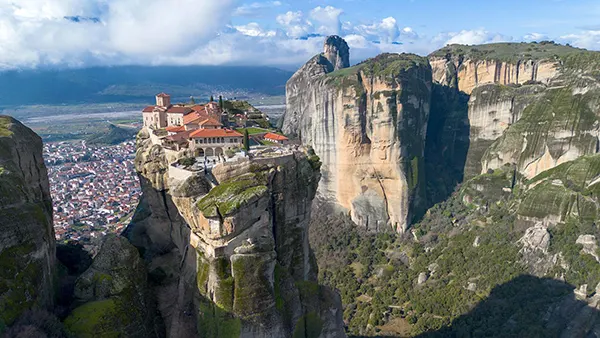
Meteora lies in mainland Greece, at the north-western edge of the Thessalian plain. Kalabaka stands directly beneath the rocks, while the smaller village of Kastraki sits closer to the western monasteries. The stone columns reach heights of up to approximately 300 metres and were formed through a long process involving the deposition of sediment, geological uplift, erosion and weathering. Seen from the valley, the formations appear separate and almost vertical, although roads, forest paths and narrow ravines connect much of the area. The landscape forms part of the Meteora–Pyli UNESCO Global Geopark, recognised in 2024 for its geological heritage. Meteora itself has held UNESCO World Heritage status since 1988 because its natural setting, monastic buildings, religious traditions and post-Byzantine art form a site of exceptional cultural importance.
Religious life in the area began long before the surviving monasteries were built. Hermits were living in caves and rock shelters by the 11th century, seeking isolation in places that could be reached only with considerable effort. Organised monastic communities developed later, particularly during the 14th century, when political instability encouraged monks to establish more secure settlements on the rock summits. At first, access depended on removable ladders, ropes, nets and wooden lifting systems. Stone stairways and bridges appeared much later. The monastic centre reached its greatest extent between the 14th and 16th centuries, when numerous monasteries and smaller religious houses operated among the rocks. Historical records differ on the total number, but only six principal monasteries now receive regular visitors.
A first visit should not be treated as a race to collect photographs of all six buildings. Each monastery has its own church, courtyards, frescoes, viewpoints and small museum areas, and the repeated climbing soon adds up. The winding road also makes distances feel longer than they appear on a map. A half-day visit usually allows enough time for two monasteries and several viewpoints, while a full day can include three without becoming exhausting. This slower pace is also more appropriate because the buildings remain places of Orthodox worship rather than ordinary historical attractions. Monks and nuns live and work within the complexes, religious services may be taking place, and some rooms are closed to the public. Quiet behaviour and attention to signs are therefore part of the visit.
The Six Monasteries and the Best First Choices
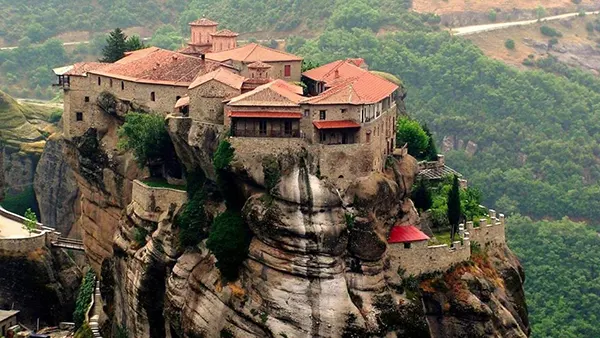
The Great Meteoron and Varlaam form the most practical pair for travellers who want a strong introduction to Meteora’s history. They stand close together in the western part of the monastic area, although each requires a separate climb from its parking point. The Great Meteoron is the oldest and largest surviving monastery. It was founded shortly before the middle of the 14th century by Saint Athanasios the Meteorite on the rock then known as the Broad Stone. Its complex includes the main church, old monastic rooms, historical collections and broad views over the northern rocks. Nearby Varlaam is the second-largest monastery and is known for its 16th-century church, preserved monastic architecture and old lifting tower. Visiting both generally takes several hours once stairways, ticket queues and interior rooms are included.
Rousanou and St Nicholas Anapausas provide a different impression of monastic life because their buildings fit tightly onto smaller rock summits. Rousanou occupies a narrow pillar near the centre of the road circuit and is now a convent. Its compact position creates clear views towards neighbouring rocks, forested slopes and the road below. The climb is shorter than some visitors expect, but it still includes steps and an elevated bridge. St Nicholas Anapausas is usually the first active monastery encountered when approaching from Kastraki. The restricted summit forced its builders to arrange the complex vertically, with rooms and chapels placed on several levels. This makes it historically interesting, but the stairway can feel demanding in hot weather. These two monasteries work well when paired with Kastraki and nearby viewpoints.
Holy Trinity and St Stephen stand on the eastern side of Meteora above Kalabaka. Holy Trinity has one of the most recognisable positions in the area, but reaching it involves a descent from the road followed by a considerable ascent on carved steps. It is better suited to visitors who are comfortable with sustained climbing. St Stephen is the easiest monastery to enter because a short bridge connects the road approach to the complex, avoiding the long staircases found elsewhere. This makes it the most realistic choice for many older visitors and people with limited mobility, although some uneven surfaces remain inside. For a balanced first trip, a common combination is Great Meteoron or Varlaam for scale and history, Rousanou for its central setting, and St Stephen for easier access.
How to Organise a First Visit Without Rushing
Choosing where to stay affects the entire visit. Kalabaka is the larger base, with the railway station, a wider range of accommodation, shops and restaurants, and straightforward access to the eastern side of Meteora. Kastraki is smaller and lies directly beneath several rock formations, making it convenient for St Nicholas Anapausas, Rousanou and the western road towards Varlaam and the Great Meteoron. Travellers without a car may find Kalabaka more practical for arrival and departure, while those interested in early walks or a quieter village setting often prefer Kastraki. The two settlements are close enough to combine by taxi or on foot, but walking between them does not remove the need to arrange transport to the higher monasteries unless a longer uphill route is planned.
Two nights are ideal for a first visit. Arrival on the first afternoon leaves time to settle in, see the rocks from the valley and reach a sunset viewpoint without trying to enter a monastery before closing. The next morning can then begin early, when roads and stairways are quieter. A second morning allows for another monastery, a short walk or a visit to the Byzantine Church of the Dormition of the Virgin Mary in Kalabaka. One night is still workable when transport times are favourable, but a same-day journey from Athens creates a long schedule. Meteora is roughly 350 kilometres from the capital, and road travel commonly takes four to five hours in each direction depending on traffic, stops and the chosen route.
A hire car provides the greatest freedom because the six monasteries are spread along a mountain road with multiple viewpoints. It also allows the day’s order to change when a car park is full or a monastery is closed. However, the driver must deal with narrow sections, coaches, pedestrians and limited roadside spaces during busy periods. Taxis and local sightseeing minibuses remove the parking problem and suit travellers arriving by public transport. Rail and coach arrangements should be checked shortly before departure rather than assumed from an older itinerary. Greek rail services have undergone timetable and replacement-transport changes in recent years, while coach journeys may require connections. For 2026 travel, tickets and current notices should be confirmed directly with the relevant operator.
Practical Routes for One, Two or Three Days
A one-day route should concentrate on two areas rather than crossing the entire circuit repeatedly. Start early with the Great Meteoron and Varlaam if both are open, then stop at one or two viewpoints on the road towards Rousanou. After lunch, choose either Rousanou or St Stephen according to energy levels and closing times. St Stephen is particularly useful at the end of the day because its bridge access requires less effort than another long stairway. On days when the Great Meteoron or Varlaam is closed, begin at St Nicholas Anapausas or Rousanou and continue eastwards. Three monastery interiors are usually enough for one day; adding a fourth often means rushing through churches, museum rooms and viewpoints simply to keep to the schedule.
With two full days, divide Meteora into western and eastern sections. The first day can cover St Nicholas Anapausas, the Great Meteoron and Varlaam, with time in Kastraki before or after the visits. The second day can include Rousanou, Holy Trinity and St Stephen, although most travellers should still choose only two interiors and use the remaining time for the landscape. This arrangement reduces unnecessary driving and makes it easier to adapt to weekly closing days. Sunset should be planned as a separate activity because monasteries normally close well before the best evening light. Roadside viewpoints remain accessible, but parking must not block traffic, monastery entrances or emergency access. A short taxi transfer is often easier than driving when the main sunset points are crowded.
A three-day stay creates enough time for a proper walking route. One recognised option begins near Kastraki and passes the Doupiani area before continuing towards the old Ypapanti monastery, the Great Meteoron and Varlaam. The full route takes roughly three hours and twenty minutes without lengthy monastery visits, so a realistic schedule should allow most of the day. Another steep historic path links Kalabaka with Holy Trinity, but the ascent is more demanding than the road approach and should not be attempted casually in strong heat. Marked routes vary in surface and condition, and mobile reception is not guaranteed between the rocks. Carry an offline map, remain on established paths and ask locally about recent rain, fallen branches or temporary closures before setting out.
Entry Rules, Access and Seasonal Planning in 2026
Every monastery sets its own timetable, and weekly closing days are not shared across the complex. Under the published 2026 summer schedule, St Stephen normally closes on Monday, the Great Meteoron on Tuesday, Rousanou on Wednesday, Holy Trinity on Thursday, and both Varlaam and St Nicholas Anapausas on Friday. Opening hours also differ, while St Stephen commonly closes for a midday interval. Winter schedules are more restricted and may add further closed days, especially at the Great Meteoron and Varlaam. Religious celebrations, services, maintenance and local circumstances can lead to changes without much notice. The day’s plan should therefore be built around confirmed opening times rather than a fixed list created several months earlier.
The current entrance contribution is €5 per person at each monastery and should be carried in cash. A visit to three monasteries therefore requires €15 per person, separate from transport, guiding or parking expenses. Modest clothing is compulsory. Men are expected to wear long trousers, while women should wear a skirt below the knee; shoulders must be covered, and sleeveless tops are not accepted. Some entrances provide wrap skirts, but availability should not be relied upon during busy periods. A light long-sleeved layer is useful even in summer because it meets the clothing rule and can be removed outside. The requirement is religious rather than seasonal, so it remains in force during very hot weather.
Access differs sharply between monasteries. St Stephen is the least demanding because of its bridge, while the Great Meteoron, Varlaam, Rousanou and St Nicholas involve substantial numbers of steps. Holy Trinity combines a sloping approach with a steep final ascent. Handrails are present in many places, but stairs can be narrow, polished or uneven. Comfortable closed footwear with good grip is more suitable than sandals with smooth soles. Summer temperatures can rise quickly on exposed stone, and there is limited shade on some approaches. In winter and after rain, damp steps require extra care. Travellers with heart, joint or balance problems should select fewer monasteries, allow longer rest periods and avoid assuming that the short distance from a car park means easy access.
Before You Set Out: A Practical Checklist
Check three items on the evening before the visit: the opening hours of each intended monastery, the local weather forecast and the transport plan for reaching the first stop. Confirm information again when travelling during Orthodox Easter, major feast days or winter, when schedules are more likely to differ. Choose one priority monastery and two alternatives rather than creating an inflexible route. This prevents a temporary closure from spoiling the day. Starting shortly after opening generally brings cooler conditions and fewer coach groups, although the most popular entrances can still become busy. When travelling by car, note the location of the monasteries in advance so that navigation instructions do not cause sudden stops on the winding road.
Carry small euro notes and coins, drinking water, sun protection and clothing that meets the monastery rules. Food should be eaten outside the religious complexes, and rubbish must be taken back to the settlements or placed in proper bins. Keep a downloaded map because wooded sections and deep gaps between the rocks may affect the phone signal. Photography is generally possible in outdoor areas, but restrictions often apply inside churches, chapels and museum rooms. Flash should never be used where it is prohibited, and visitors should not photograph monks, nuns or worshippers without permission. A compact camera or phone is easier to manage on stairways than bulky equipment, particularly when entrances are crowded.
The most satisfying first visit combines a small number of monastery interiors with time to understand the wider setting. The rocks change appearance throughout the day as light moves across the cliffs, and the view from the valley is as important as the summit panoramas. Staying in Kalabaka or Kastraki supports a calmer schedule and reduces the temptation to treat Meteora as a brief stop between distant cities. It also leaves room for local meals, an evening walk and a morning route before the main traffic arrives. With verified opening times, sensible footwear and a route suited to personal mobility, Meteora can be visited without excessive planning or technical hiking knowledge. The essential decision is not how many monasteries can fit into one day, but which few can be seen properly.
Popular articles
-
New Lucas Museum in Los Angeles:...
The Lucas Museum of Narrative Art …
-
Limassol and City of Dreams Medi...
Limassol is one of the easiest …
-
Discover Copenhagen: A Vibrant C...
Copenhagen, Denmark’s vibrant capital, effortlessly blends …