Taj Mahal (India): a love story, architecture, and visitor rules
The Taj Mahal in Agra is often reduced to a postcard image, but it makes more sense when you read it as a carefully planned memorial and an engineering project on a difficult riverside site. It was commissioned by the Mughal emperor Shah Jahan after the death of his wife Mumtaz Mahal, and its fame comes from how successfully it combines private grief with public statement: power, faith, craftsmanship, and an almost obsessive commitment to symmetry.
History: who built it, why it mattered, and what the dates actually mean
Mumtaz Mahal died in 1631, and her body was later brought to Agra for burial in the tomb complex. The Taj Mahal is not only her mausoleum: Shah Jahan himself was eventually buried there as well, which changes the “single tomb” narrative into a dynastic one. The complex that visitors see today is therefore both a personal monument and a piece of imperial memory-making.
The build took time on a scale that is easy to underestimate. The Archaeological Survey of India notes that the overall complex was completed in 1648 and that the work took 17 years. Those years included not just the marble mausoleum, but the forecourt, gates, mosque, guest buildings, gardens, and the riverfront setting that frames the view from the main axis.
It is also worth remembering how international the craftsmanship was. The ASI describes teams of masons, stonecutters, inlayers, calligraphers, and dome builders drawn from across the empire and also from Central Asia and Iran. Materials came from far beyond Agra: white marble from Makrana in Rajasthan and semi-precious stones sourced from regions including India, Ceylon (Sri Lanka), and Afghanistan.
The love story and the politics: why both interpretations are true
The “monument of love” label endures because the commission followed a real, documented loss, and because the design language encourages an intimate reading: the serene tomb chamber, the softness of light on white marble, and the calm geometry of the garden. Even if you arrive sceptical, the building’s atmosphere tends to push you towards quieter emotions rather than spectacle.
At the same time, the Taj Mahal is unmistakably political. Its scale, materials, and precision advertise the reach of Mughal resources and skill, and the location on the Yamuna links it to the river’s symbolism and to the broader urban landscape of Agra. In other words, personal grief and statecraft are not competing explanations here; they are layered on top of each other.
Seeing both sides helps you read details that are otherwise easy to miss: inscriptions that do more than decorate, strict bilateral symmetry that feels almost enforced, and a site plan designed to manage movement and sightlines. The building is moving because it is controlled; that tension is part of what keeps it compelling centuries later.
Architecture: what to notice beyond the famous façade
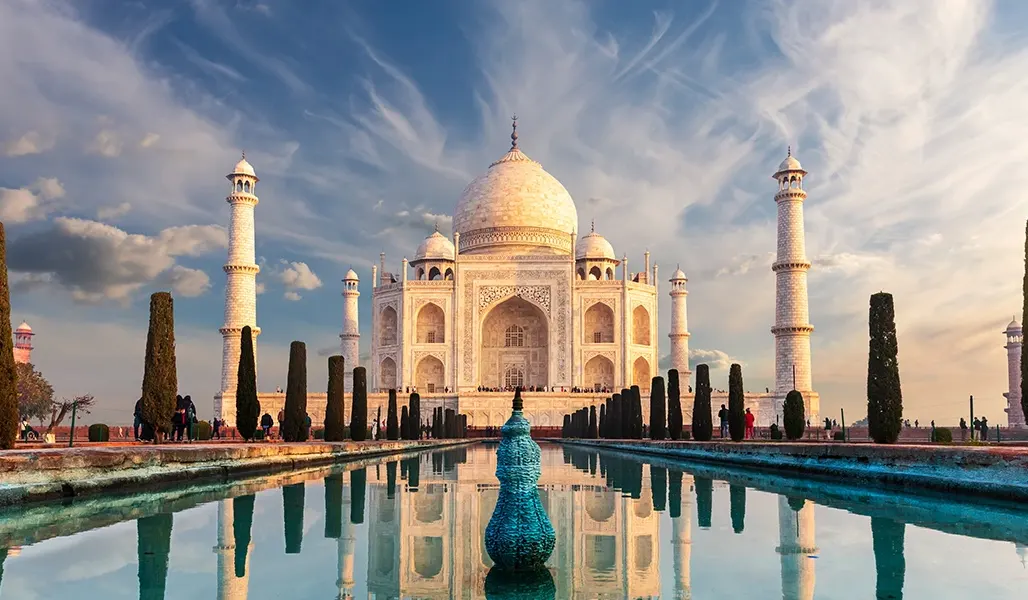
The main mausoleum sits at the end of a long, formal approach, and the sense of arrival is engineered. The garden axis, water channels, and framing gateway work together so that the tomb appears to “grow” as you walk forward. This staging is not accidental: it is a classic Mughal way of turning landscape into architecture.
Look closely at the marble rather than treating it as a single white surface. The ASI highlights the use of Makrana marble for exterior veneering and the import of semi-precious stones used in inlay ornamentation. In practice, that means you will find intricate floral and geometric work that is easiest to appreciate when the light is soft and angled.
The riverbank location also mattered technically. The ASI explains that a network of wells was laid along the river line to support the massive structures. It is a reminder that this “light” building required heavy, practical foundations—especially on ground that slopes towards the Yamuna.
Symmetry, materials, and the visitor’s “best view” problem
Most people photograph the same central viewpoint, but the Taj rewards slower looking. Symmetry is the headline, yet the surfaces are full of tiny decisions: spacing in calligraphy, changes in motif scale, and the way the dome’s curves visually soften the building’s strict geometry. If you have limited time, focus on one panel of inlay work and follow it with your eyes rather than rushing for another angle.
Materials also change your experience depending on weather. The marble can read as cool grey in winter fog, warm cream in late afternoon, or almost blue-white near dawn. That is one reason the monument’s opening hours are tied to sunrise and sunset: the building is designed to be seen in natural light, not under harsh midday glare.
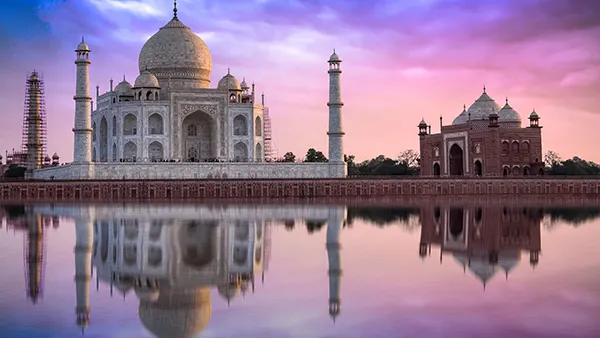
Finally, remember that some of the most satisfying views come from outside the complex. A late-day look across the river or from nearby gardens can help you understand the site as part of a larger landscape, not just a standalone object. It is a good way to balance the close-up detail of the inlay with the overall composition.
Rules for visiting in 2026: tickets, timings, queues, and what gets you stopped at security
For general daytime entry, the Taj Mahal opens 30 minutes before sunrise and closes 30 minutes before sunset, and it is closed on Fridays for general viewing. Ticket windows are timed around daylight, opening one hour before sunrise and closing 45 minutes before sunset, and there are separate queues for domestic and foreign visitors.
Official prices are straightforward but easy to misread if you do not notice the optional add-on. The base entry fee is ₹1,100 for foreign tourists, ₹540 for citizens of SAARC and BIMSTEC countries, and ₹50 for domestic/Indian visitors (including OCI cardholders). To enter the main mausoleum, there is an additional ₹200 charge on top of the regular ticket.
If you book online, the official site notes a small discount: ₹5 off per Indian ticket and ₹50 off per foreigner ticket. Children under 15 have free entry. In practical terms, online purchase can also reduce queue time at the gates, but you should still plan for security screening at busy hours.
On-site do’s and don’ts: what you can carry and how night viewing works
Security is strict and the prohibited list is longer than many people expect. Drones are prohibited inside and around the Taj Mahal, and eating and smoking are prohibited inside. Items such as arms and ammunition, tobacco products, liquor, many food items (including sweets), knives, wires, tripods, and various electrical goods (other than a camera) are also listed as prohibited, so travel light and avoid large bags.
Photography is prohibited inside the main mausoleum, and staff will ask visitors to keep mobile phones switched off or on silent mode. The Taj Museum inside the complex is open from 10:00 am to 5:00 pm with free entry, which can be a sensible stop if you want context and a short break from the crowds.
Night viewing runs on a separate system and only on five nights each month: the full moon night, plus two nights before and two after. The official timing is 20:00 to 23:59 in eight batches (maximum 50 people per batch), with 30 minutes per batch, and visitors are told to report at Shilpgram 30 minutes before their slot for security checks. Ticket prices are listed as ₹750 (foreigner), ₹510 (Indian adult), and ₹500 (child aged 3–15), and night viewing is closed on Fridays and during Ramzan.
Popular articles
-
Cappadocia, Turkey: how to plan ...
Cappadocia is one of the most …
-
Sintra (Portugal): Palaces and P...
Just thirty kilometres west of Lisbon …

-
Great Wall of China: Which Secti...
The Great Wall of China stretches …